NEW YORK, December 2024 – When Sabir Khamis, 33, left Ghana for the United States, he never imagined it would be an Egyptian-run mosque in Colombia that granted him solace after a tumultuous journey through Brazil, Bolivia, and Peru.
In the summer of 2023, the As-Salam Masjid of Medellín offered him community, brotherhood, and support, while he had to bury his travel companion, Husseina. A distant relative of his, she had applied without avail several times for a family visa to reunite with her husband, an American-Ghanaian citizen. Thus, she was forced to take the perilous overland route with Khamis and three others. In Peru, most recovered after falling ill, but by the time they reached Colombia, Husseina died of lung failure.
“Allah made his will,” said Khamis on a warm November morning in Yonkers, NY, over a year after leaving Medellin. Even thousands of miles away from home, he knew he needed to honor Husseina with a proper janazah, an Islamic burial.
Faith, as for many migrants, was Khamis’ last lifeline to hold on to, especially in the darkest moments.
“It was the first time I experienced someone dying with me, and I was alone there,” he recounted, “I was very confused, but, lo and behold, Allah gave me basira, clarity, that I had to do something”.
Upon his arrival at Masjid As-Salam, not too far from the hospital where Husseina drew her final breath, Khamis was welcomed by an Egyptian Imam who had been living in Colombia for over 15 years. Although the community had been founded by North African migrants, according to Khamis, most of the congregation was now composed of local converts. “Every day, someone would come in, professing their shahada [testament of faith in Islam].” The local congregation assisted him with Husseina’s burial. The imam was impressed by Khamis, whose faith and Islamic knowledge inspired the community.
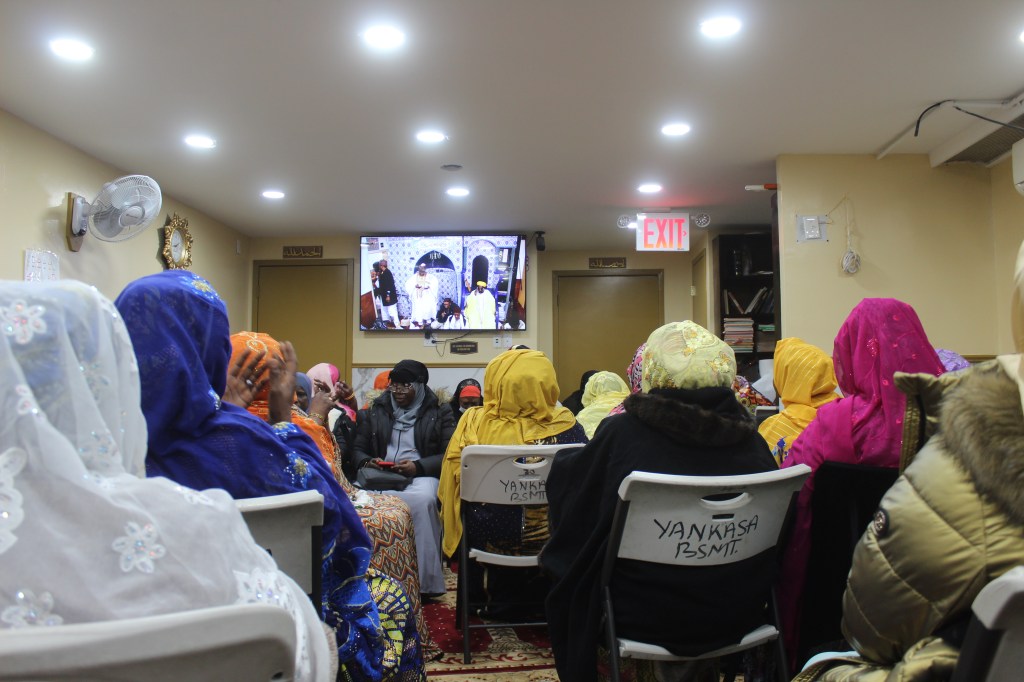
Thousands of miles Northeast of Medellin, a mosque in the Bronx, Yankasa, continues to provide community and shelter to migrants, particularly from West Africa. Founded spontaneously and organically in the 1980s, Yankasa is a Ghanaian association that, for over 40 years, has offered West African immigrants in New York to find a home away from home. On the mosque’s sidewalk, street vendors from the community sell traditional stews, the perfect meal to warm up on a chilly December afternoon.


2023 alone saw over one hundred thousand migrants arriving in New York City, many of whom came from West African countries. The surge in migrants coming from this geographical region is fueled by several reasons, mainly economic hardship pushing young men to leave their families and country in search of more financially comfortable lives.
At the height of last year’s migration crisis, before the City’s current shelter system was set up, Yankasa hosted over one hundred West African migrants on their carpeted floors. “We had an open door policy for those coming,” said Yankasa’s Sheikh Mahmoud Cisse. “The state in which they came was so bad that even though the facility is not built to host people, we had no other choice.” Months later, the young men who were welcomed, fed, and nurtured while on the streets keep returning to the mosque.
“It is Islam that brings us together,” said Ibrahim Abdulai, President of Yankasa, on a Friday afternoon after the Jummuah prayer. “Even though we all come from different ethnic backgrounds and have different cultures, Islam overrides any culture.” In front of the mosque, congregation members greet one another in the dozens, wishing peace upon each other.
It was here that, months after leaving Kumasi, Ghana, Khamis found a taste of home at the end of his life-threatening journey across the Americas. When he arrived in New York, Khamis was introduced by his uncle, who has lived in the City for over twenty years, to the well-established Bronx community of Ghanaians. Men and women don colourful garments that contrast with the greyness of New York’s concrete buildings. According to one saleswoman displaying traditional robes of all sorts of prints and patterns, they come directly from home, from Ghana. During the Jummuah sermon, Imam Salley remarked on the importance of practising patience (sabr, a key Islamic value), especially when the worldly life (dunya) becomes hefty. “Only your kindness and good deeds will testify for you and protect you on the Day of Judgement,” he stressed into a microphone, which allowed the entire congregation to hear his words. Believers, sitting cross-legged on the red and golden carpet covering the floors of the three-story mosque, let the words sink in through pensive nods. In the women’s section, the sisters sat together in a circle once the prayer had ended and listened in awe to a lady wearing an emerald green hijab reciting the Quran.
“The community is designed in a way that everything you want African, you can get,” said Khamis, “African clothes? There is. African food? There is.” With a timid smile, he adds, “The only thing from home they don’t have here are my wife and children.” He hopes to get them to visit or even move to the States, but until his court hearing comes, there is little he can do, even for himself.
Son of the local sheikh back in Ghana, Khamis became a hafez at the young age of 15 when he memorised the entire Quran. Ever since the age of 17, he has taught the Quran to other students, so that everywhere he went, he kept this practice going. Now, even in New York, he puts in the effort to make the time – when he is off his shift from being a security guard at Whole Foods – to teach students from South Bronx. The mosque he teaches at is called “All Muslims Center”, and little did he know when he first showed up there that the centre’s Imam was a long-lost friend of his from high school. “We had both won a scholarship to pursue religious studies in Turkey, but I had ended up not going.” As they say, ‘coincidence is God’s way to stay anonymous’. And thanks to that coincidence, Khamis got his part-time job as a Quran moallim, teacher, which he describes as a “blessing, a source of immense joy and fulfilment.”
Khamis has always relied on verses of the Quran to find comfort throughout his hardships.
“I was thinking about this aya [literally “sign”, meaning Quranic verse] all the time while I was taking that dangerous route,” he said, remembering particularly the fear and discomfort of having to cross the Darien Gap, a section of jungle that stands as a border between Colombia and Panama, infamously known by migrants as a death trail. ” وَلَا تُلْقُوا۟ بِأَيْدِيكُمْ إِلَى ٱلتَّهْلُكَةِ ۛ , Don’t let your own hands throw you into destruction.” He knew he had put his life in danger, but this was the only alternative he had to Ghana, where economic hardship placed increasing burdens on his family’s livelihood. “It is everybody’s dream to make it in their own country,” says Khamis, who graduated with a marketing degree nearly 8 years ago from Kumasi Technical University, just to then move to Dubai to work for cheap labour. Until then, he had only studied in his life, and even though he didn’t come from a wealthy background, his family always wanted to prioritise his education.
Khamis’ dream (and his father’s, who was “the pioneer of Sunni Islam in Ghana”) was to obtain a scholarship to study in Medina and pursue a career to become an Islamic scholar. After applying several times without avail, he read it as a sign that he should cover a different role and become the household’s main provider. This mentality and heartbreak in Ghana pushed him to move to Dubai in 2017, where he lived for 4 years. Working at a mattress company, Khamis says he faced the worst discrimination and racism in his life there. “I don’t know if it’s because I am black, or because I am Muslim, or both, but they really gave me a hard time,” he said, referring to his bosses.
Nevertheless, he views this period as an example of God’s mercy and, in hindsight, sees the kheir, the goodness, of what was a horrible experience at the time. “I had a hard life there, but the goal was never to stay in Dubai long-term.” Indeed, he had hoped to go to the UAE to make enough money to return to Ghana and marry the woman whose family’s rejection had broken his heart. Instead, as she got married to someone else while he was away, he came back and married the woman who became the mother of his two children, saved in his phone as “Love of my life.”
“ وَعَسَىٰٓ أَن تَكْرَهُوا۟ شَيْـًۭٔا وَهُوَ خَيْرٌۭ لَّكُمْ ۖ وَعَسَىٰٓ أَن تُحِبُّوا۟ شَيْـًۭٔا وَهُوَ شَرٌّۭ لَّكُمْ ۗ وَٱللَّهُ يَعْلَمُ وَأَنتُمْ لَا تَعْلَمُونَ”
“And it may be that you hate a thing and it is good for you, and it may be that you love a thing and it is bad for you, and God knows. And you do not know”
Islam plays a great role in many of NYC’s immigrant groups. Being the fastest-growing religion in the world and the only religion in the US that has more people converting to it than leaving it, it deserves a degree and an angle of attention that might have been underestimated until now. Nearly one-fourth of America’s Muslims live in NY and are composed of great ethnic and national diversity. Contrary to common belief, the majority of Muslim populations worldwide aren’t Arab, with only about 20% of Muslims globally being Arab. Sub-Saharan, South Asian and East Asian Muslims constitute the biggest chunks of the Muslim population, and this is reflected in New York’s mosaic.
“Without tolerance, you cannot live in a society, and we need to make sure we respect other cultures,” replied Yankasa President Abdulai when asked how, as a community leader, he balances upholding Islamic values while in a non-Muslim country. The Yankasa administrative board expressed gratitude towards the First Amendment and, more broadly, towards the American Constitution, as it firmly guarantees Freedom of Religion. Nevertheless, they are aware that many first-generation youth can be guided away from the faith and sometimes feel confused between the potentially conflicting identities of being Ghanaian, Muslim and Western. This was another reason that led the forefathers of Yankasa to found the association in the 1980s: providing Islamic education to the migrants’ children through weekend school classes.
Khamis also observes that raising children in the US is a challenge for practising Muslims, and he weighs the trade-off between having his family with him here versus back in Ghana, where they are surrounded by a sense of cohesivity and community that, while impressive, the Amerian reproduction of it cannot be matched to. He says that his uncle, who had come to the States nearly three decades ago to uplift his economic status, admonishes him to avoid making the same mistake. “He could easily move back to Ghana now and live comfortably,” says Khamis about his uncle, “but what for? His life is here now,” suggesting that he resents having abandoned his roots. Khamis misses home, but he is still committed to wanting to succeed for his family.
When Khamis decided to leave his country for the US, he hadn’t initially planned to do so the ‘hard way’. He thought he would get an F-1 Visa after getting into a Business Management Master’s program with a scholarship at Ball State University in Indiana. Instead, his visa application was rejected because the bank statements were insufficient to prove his ability to support himself in the country. After many sleepless nights, he and his family agreed upon him flying to South America, accompanied by other Ghanaians, one of whom was his brother-in-law’s stepmother, Husseina.
Throughout the countless buses, cars, and roads he took to cross the flexible borders of several countries, he felt a looming sense of sadness, maybe a foresight of what would befall him in Colombia. It was the first time Khamis felt such a piercing cold cut through his bones. In Peru, when they were in the mountains and unequipped for the high-altitude icy temperatures, the entire group caught a severe cold, which, although with minimum rest and little medicine, went away in a few days. Husseina, however, showed no signs of recovery, and when the crew got to Medellin, she collapsed. The others all went ahead, leaving her to her fate; they couldn’t afford to stay there for longer than two days. Khamis stuck with her, taking the risk of bringing her to the hospital. The first night she was there, the doctors told him she would get better with the proper care, and she did. She seemed to be able to breathe again, walk again, migrate again. But as they left the hospital to check in the hotel, Husseina collapsed. By the time she was brought back to medical care, her lungs had failed, and she had passed away. Khamis prayed for her soul, not knowing what to do next.
Husseina’s husband, who was waiting for her in America, flew into Medellin after Khamis contacted the Egyptian mosque. Khamis’ uncle – not the one in the Bronx, but one with Belgian citizenship who was in Brazil for business – also joined. Now, he was less alone, awakened for a fortnight from the nightmare that had been the attempt to make it to the US. Grief, confusion, and faithfulness amalgamated during that time, and on the day after the Janazah was held, Khamis said he lived the saddest 24 hours of his life. His uncle and Husseina’s husband went to the airport that morning, boarding planes that would bring them where they needed to be in a matter of hours. Meanwhile, he was preparing mentally and physically to approach the Darien Gap.
“That day was one of my saddest days,” he said. “I was just asking myself: Allah created this world. He gave us this land and everything on it. And why is it that some people are able to travel by air because of documents, and I can’t? I embraced my Qadr [God’s will] and said, ‘Okay, whatever Allah has ordained for me, so be it’.” And he boarded the bus, which dropped him off at Capurgana, the town closest to the jungle. It took him two and a half days to cross it, and all he could say about it, other than “Alhamdulillah, thank God, I survived,” was: “You cannot believe how many corpses, of children, of elderly, of cripples, I encountered.”
Indeed, Sabir Khamis survived. Not only did he survive, but, as a testament to his name, literally meaning ‘He who is patient’, he got to the US and found the strength to start every day with faith, gratitude, and a smile. Through short-term employment and minimum wage – before his current job as a security guard – he put aside enough money to fulfil one of his dreams: being able to pay for his mother’s Hajj, the pilgrimage to Mecca, which is one of the five obligations Muslims must comply with if they can afford it.
On that warm November morning, Khamis watched with awe and pride a video of his son, Abdul Rauf – whom he named after a late childhood best friend – reciting Surah al Fatiha, the Quran’s opening Surah, a prayer for guidance and mercy. His 3-year-old voice makes the recitation particularly sweet. Abdul Rauf’s focused, big, dark eyes look into the camera, and Khamis looks back at them, longing to embrace his family.
He repeats, “It’s okay. I accept my Qadr. Alhamdullilah. Praise be to God.”
Walking down a bridge connecting Yonkers and the Bronx, Khamis recites Surah al Taha without any timidity on his way to the subway. His voice is louder than the cars zooming below on the highway. The impeccable Arabic pronunciation elevates the casual stroll into a solemn moment
مَآ أَنزَلْنَا عَلَيْكَ ٱلْقُرْءَانَ لِتَشْقَىٰٓ
مَآ أَنزَلْنَا عَلَيْكَ ٱلْقُرْءَانَ لِتَشْقَىٰٓ ٢ إِلَّا تَذْكِرَةًۭ لِّمَن يَخْشَىٰ
We have not revealed the Quran to you to cause you distress,
but as a reminder to those in awe of Allah.
“Always, wherever I find myself, whatever comes to me,” he says, “the Quran, having memorised it – it became a light in my life.”
 Carolina Pedrazzi
Leave a comment