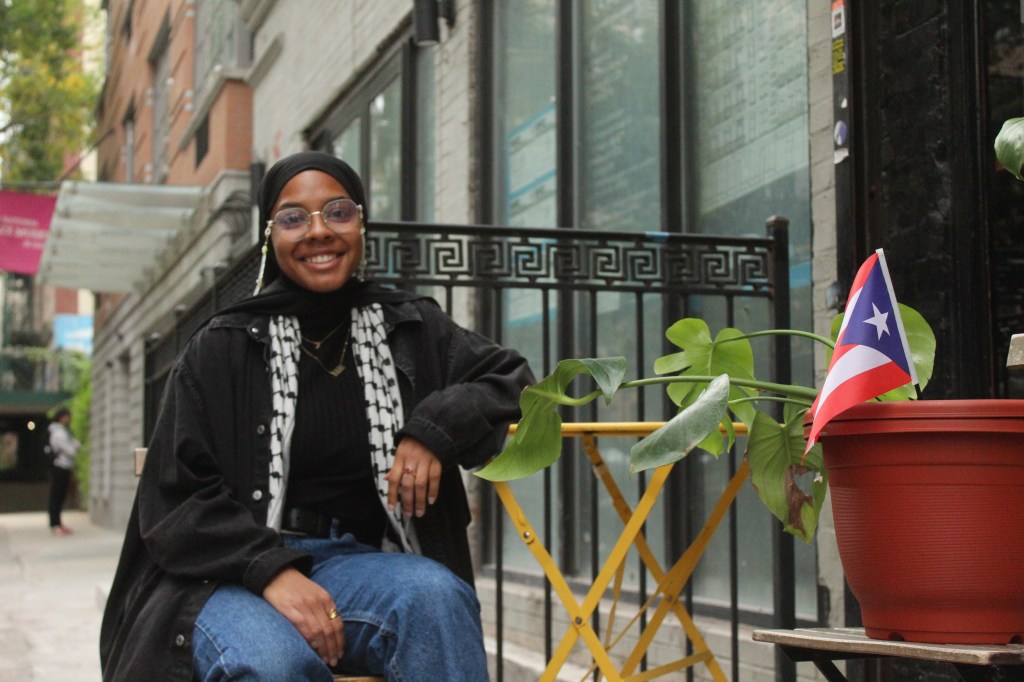
Alyssa Monet, a Puerto-Rican revert to Islam, poses at a coffee shop in Harlem. Fall 2024, Carolina Pedrazzi
Latinos in America are converting to Islam in the thousands. How does identity, the upcoming Presidential elections, and faith play into the political behavior of this “minority within a minority”?
To reach the café in Harlem where Alyssa Monet arranged our interview, I walked up Malcolm X Boulevard for about 30 blocks. The eclectic nature of Harlem and its people is reflected in how faith has nestled itself in various buildings. On one corner, a Baptist church stands next to a Mormon temple, while on the other side of the road, the emerald-green dome of the Malcolm Shabazz Mosque towers over the surrounding buildings.
Harlem is just one of many places where Islam belongs in the households and hearts of New York residents, and the faith is increasingly drawing people from diverse cultural and heritage backgrounds.
Moving to New York from Italy as a Muslim convert myself, I was curious to explore how and why communities in America were taking this leap of faith outside of their religion and cultures. Growing up atheist in a predominantly Catholic country, I thought I would find familiarities in the experiences that led Latinos to take interest in Islam. Given I was first exposed to the religion while working in refugee camps on the border of Europe, and later by reporting in different Middle Eastern countries, what most interested me was exploring the universality of this journey. Indeed, while I was already aware that Islam represented the fastest growing religion in the US, I was intrigued to find out that Latinos and Latinas constitute the biggest chunk of the population taking their “shahada”, the Muslim testament of faith.
Amidst an increasingly polarized political climate, just days away from the Presidential Elections, with polls still showing tight ties between Harris and Trump, I looked at voting intentions of this particular community, Latino Muslims. While Hispanic voters have been increasingly turning towards the GOP over the past 20 years, the Democratic Party expected to lose over 15% of its Latino voters in the 2024 elections, Muslim communities have predominantly voted Democrat, with only 17% of American Muslims identifying Republican as of May 2024. However, Biden’s unpopular handling of the War in Gaza has distanced Muslims from the Party, leading many to either abstain or vote Third Party.
Over the course of weeks, I met with and talked to several Latino New Yorkers who embraced Islam in their early adult years, converting to a religion that is often perceived by their families as the polar opposite to their own culture.
——————————————————————————————————————————
Sitting at 787, a popular Puerto Rican-owned coffee shop, Alyssa, 25, sips her coffee as she settles into her chair. We’re seated outside, just below the café’s speaker, which is booming upbeat Hispanic music, even though it’s only 10 a.m. We agreed to meet here because we knew we would be talking about culture, faith, and identity, and, given Alyssa is partly Puerto Rican, 787 felt like the ideal spot to connect with her roots.
As she tells me about her conversion to Islam, “tears of gratitude” well up in her eyes, while her voice reveals her soulful character with each sentence. When I first met Alyssa, I had timidly asked if I could pray with her in Washington Square Park at the end of a pro-Palestine march that I was reporting on. I saw her lay a prayer mat on the grass, and I remember being surprised because, coming from Europe, I had never seen anyone in a non-Muslim country pray in public. With her warm and welcoming smile, now familiar, she immediately invited me to join, saying I shouldn’t even have to ask.
Her conversion story is deeply rooted in her political engagement and identity. “When things exploded in Palestine, I decided to go out and protest,” she recalls, “I had been studying about the Black Panthers, the Black Liberation Movement and its connections to Palestine. I was immediately like, I know these are my people. I know this is my struggle.” Alyssa is a graphic designer from Brooklyn, and dedicates plenty of time to social justice activism in the City. As a half-Black, half-Latino (Puerto Rican and Italian), young Muslim woman, different realities intersect to shape her worldview. “Before, people would stare at my afro, and from that came one form of racism. Since wearing the hijab, everyone assumes I’m Arab, and that brings a whole different societal treatment.”
Her different ethnic, cultural, and religious backgrounds, which make her identity polyhedric, lead her to empathize with many liberation struggles. Indeed, what brought her to finally making the decision to convert to Islam after years of being curious and learning more about the religion, was her involvement with the pro-Palestine marches.
“I remember that even at the height of a protest, everybody would stop. They’d halt the police anywhere, cause it was time for Salah, it was prayer time.” Alyssa was moved by such collective remembrance of God and decided to buy the Qur’an. Describing her first reaction to reading it she said “It just felt like everything was there! Questions I didn’t even know I had were answered, and everything just made sense.” This came after years of her trying to get closer to God during which she thoroughly read the Bible, but often felt a void and as if something was missing.
Something which almost all of my interviewees talked about, was the theological clarity they found in Islam. Yousef, 21, describes how this resolved the “intangible” concept of the Trinity within Christianity. In Islam Jesus is a prophet – one of the most important ones – but is not considered to be either God or His son.
Alyssa is just one of many Americans who have been drawn or exposed to Islam by the recent wave of awareness raising of the Palestinian cause. As explained to me by University of Pittsburgh Professor of Law SpearIt, – he always only goes by his first name, pronounced “Spirit” – most conversions to a faith occur after a traumatic experience. Professor SpearIt specializes is and is the pioneer researcher on conversions to Islam in US prisons. “With everything happening in Palestine, I believe we will see an increase in interest in Islam,” he said.
SpearIt argued in his recent article Palestinian Blood, Seed of the Mosque, that online witnesses of the war in Gaza through social media are going through a secondary or indirect trauma, which breeds interest towards seeking faith. In the case of Latino Muslims who converted in prisons, Professor SpearIt said that, for many, Islam brought a sense of peace to inmates who had suffered from traumatic experiences due to their affiliation with gangs. His studies show that the new faithful (both among Latino and Black Muslim converts) are much less likely to return to criminal activities after completing their sentence, than non-converts.
Israel’s war in Gaza, which started over a year ago after Hamas’ attacks on October 7th, 2023, might play a big role in the voting behavior of many American Muslim communities, who see their Palestinian brothers and sisters in faith killed by Israel’s retaliation, funded by their own government.
Alyssa, who voted for Biden back in 2019, said “the Palestine movement has just made me completely disillusioned with our political system.” While she will be casting a ballot, she will no longer vote for the lesser evil, as she cannot morally stand with either Party.
Political allegiances among Latino Muslims are not monolithic. While Alyssa feels disillusioned by both major political parties, Tusha Diaz offers a different perspective.
Tusha Diaz is a New York businesswoman in her 40s with heritage from the Dominican Republic. She is also the founder of Latino Muslims of NYC, a grassroots organization bringing together the roughly 6,000 Latino and Latina converts in New York.
Speaking to me on the phone, while she was at a house expo, and was taking care of her grandson, Tusha started telling me the story of her life and how Islam found her when she most needed it.
“By the time I was almost 20, I realized I couldn’t live like that anymore,” Tusha said, addressing her upbringing in NYC filled with sorrow and hardships, and a difficult life situation as a young single mother of two. It would take her another ten years to actually convert to Islam, but that period in between, at the beginning of which she moved to Florida, was fundamental.
A few years after having resettled to Tampa from NYC, Tusha recalls her son being invited to a classmate’s birthday party. When she took him to the gathering, she realized she was the only non-Muslim and non-Arab there. She was welcomed to sit with the children’s mothers, who were huddled around a box tv. “This was around the time when Bush had just invaded Iraq, so I figured they were watching the news, maybe Al Jazeera. I wasn’t sure what was going on, so I just sat there, watching.”
She recounted the interaction which first made her feel she wanted to become part of that community. All the ladies were wearing headscarves, hijabs, and, while Tusha wasn’t, she “[a]lways liked to dress modestly,” and that made her feel a sense of belonging she had never experienced before in her Catholic upbringing.
“She was so kind to me,” Tusha recalls about the party’s host, “She said ‘You are welcome here. This is now your house, and we are family. You can come anytime.’ And I knew she meant every single word.”
At the time, Tusha knew nothing about Islam, other than the tropes she had learnt on Muslims being terrorists and hostile people. But through Faten, the Jordanian woman who had opened her home to her, Tusha spent the following years unlearning those tropes, and became integrated in a community which supported her and showed her love through the hardest times.
However, it wasn’t until she moved back to NYC, “just after we elected Obama,” that Tusha took her shahada, while she was far away from the Tampa community. “Alhamdulillah, Praise be to God, even though things were tough, Allah had a plan for me.” Tusha was struggling financially and almost became homeless.
In a moment of desperation, Tusha reflected on her life, asking God, “What do you want from me? Where do you want me to go?” It was during this time of seeking and uncertainty that she experienced a profound shift. As she walked through the streets, she found a quarter on the ground, which inspired her to call her former landlord from over 10 years prior. An unexpected turn of events led her to finding an apartment where she could start anew. “I just needed to be inside,” she recalls, still getting goosebumps from the gratitude she lived as she drank water and wept on the sofa, thanking God for a roof over her head.
That night marked a turning point in Tusha’s journey. She had a dream about a large book, which she later recognized as the Qur’an. “I know this sounds unbelievable, but it’s the truth,” she insists, “Islam was calling me.”
Soon later, she visited a Yemeni mosque in the Bronx for the first time, where the sound of the adhan, the call to prayer, moved her deeply. “It was like everything clicked,” Tusha recalls. In that moment, over 15 years ago now, she felt an overwhelming sense of belonging, gratitude, and purpose, and converted to Islam.
In the upcoming Presidential elections, Tusha endorses Donald Trump, while having been a vehement supporter of the Palestinian liberation movement for nearly a decade in the City. “When I decided to support Trump, I faced a lot of backlash in my community. People said, “What are you doing? He supports Israel.” She believes that regardless of who the President will be, America will continue to have the same interventionist foreign policy, so she should vote for who has a better domestic agenda. As she supports tighter rules on migration, border control, and abortion, she believes that Trump would be a better fit than Harris. She did not voice concern regarding Trump’s 2017 “Muslim Ban” nor on his administration’s Islamophobia.
Tusha, who used to be a Democrat until the end of Obama’s presidency, describes herself as someone with a compelling passion to serve those in need. “After all those years of hardship, I have come so far,” she says, after telling me about her medical spas across NY and her studies at Surgical Tech School, “and I believe that is because I have always kept giving back to people.”
Ms Diaz has been fundamental in creating a space in New York for Latino Muslims.She established a food pantry in the Bronx, brought thousands of new muslims together and, inspired by the Houston-based “Islam in Spanish” organization, is fundraising to build New York’s first Latino mosque.
“Because of my conversion, I stopped getting invited to family Dominican events.” Ms Diaz narrates, when asked about how her community reacted to her embracing Islam. “No one invited me to Thanksgiving anymore since they knew I didn’t eat pork. It’s been hard, and it still is.”
This is why she decided to found Latino Muslims of NY, to create a safe, familiar space for Latinos who were facing the experience she went through after converting. She complained about the preconception that Islam is only applicable to certain cultures, namely Arab or Desi. “We can still hold on to our Latino heritage and be Muslims”, denying the idea that one identity should preclude the other.
While many Latino converts have felt that entering Islam might have alienated them from their cultural backgrounds, Mike Velez, a nurse based in New York who converted to Islam four years ago after being inspired by his Muslim peers during COVID, says “embracing Islam has allowed me to embrace my Puerto Rican heritage more than I ever had before.” Growing up in a white area, his father faced a lot of racism, and his parents didn’t want him to endure the same discrimination, so had always told him to present as Italian, his mother’s ethnicity.
“Accepting Islam was not a rejection of my identity, but a renewed recognition of it,” he said. “I feel more connected to my heritage than ever before, and I’ve found a peace within myself that was missing previously.” Additionally, his accepting of Islam did not burden his Catholic family, who were pleased to know he had found faith.
Professor SpearIt, who is not Muslim but has Mexican roots, suggests that, for many Latino (and Black Americans) who were brought up distanced from their original ethnic traditions, learning about Islam represents a way to reclaim the pre-colonial narrative of their identities.
“This connection to Moorish Spain is significant for many. They find themselves drawn to the rich history of coexistence among Muslims, Christians, and Jews in Spain and want to reconnect with that heritage,” he said, after highlighting the many linguistic links between Arabic and Spanish.
Mike’s position regarding the Presidential elections is the lesser of two evils, although the disappointment and “disgust” with the Democratic Party’s backing of Israel’s war in Gaza still plays a great role in his voting decisions. “However, I think a Trump administration would enable and empower Israel’s brutal regime even more.”
Mike is skeptical about Jill Stein, the Presidential candidate for the Third Party. “I strongly feel that predatory people like Stein are using the grief of the Muslim community to try and capitalize on the election. She’s weaponizing the suffering of our community as an opportunity to throw the election to Trump.” He will vote for Harris, as he believes the only way to change AIPAC’s interference with American politics is by having more liberal justices appointed to the Supreme Court, who will overturn laws allowing corporate donations from lobbies.
The youngest new Latino-Muslims I talked to felt most distanced from wanting to engage in the elections, although both describe themselves as individuals with strong socio political beliefs. For both David Alvarado, 24, whose family is from El Salvador, and Yousef, 21, whose parents are from Puerto Rico and who didn’t give his last name, the political debate is beyond salvageable. Neither will take part in the election, although Yousef might cast a blank ballot.
“Both parties are very lost, only trying to prove how better than the other each one is, without providing any valuable contribution to our country’s decline” said David, who comes from a Catholic upbringing and has started considering himself Muslim for a few months.
“At the end, they’re two sides of the same coin”, said Yousef, whose Puerto Rican father had converted to Islam in his youth, but passed away in Yousef’s childhood, forgoing the chance to impart any Islamic education on his son. “While my family finds Trump to be better, I personally can’t support him,” he says, ” Because I don’t want my name to be on a list that endorses any politician allowing the murder of babies in Palestine.”
David, a public health student, said that “becoming Muslim perfected his love for Jesus,” who is a Prophet in Islam, but not considered to be God. He lives in full appreciation of both his communities: his family’s Catholic one, and the Muslim one he built while living in Beirut over the past year. Yousef, who works in sales in Harlem, said that while being brought up in a Catholic household, he always felt like he was Muslim, and that he wouldn’t have been drawn to Islam if it weren’t that most Christians surrounding him “don’t practice what they preach, and call themselves Christian without following the faith.”
While being a small pool of samples from the much vaster, more diversified reality of Latino Muslims, all shared a similar anecdotal story about how their abuelas or other family members reacted to their conversions. Specifically, Alyssa’s grandmother gave her no problems about the hijab, about praying five times a day, or about her interest in learning Arabic, but she was not happy about the no-pork edict. Similarly, Mike’s grandmother was extremely offended when her grandson did not eat her food during his first Ramadan, as he was fasting. Others, like David, still grapple with finding how to balance their faith with past habits, including consuming alcohol and praying outside of pre-established times. “Islam is about peace and humbleness, which we can exercise by lovingly submitting to God,” David said, who was introduced to the faith when engaging in arduous philosophical and theological conversations with a Lebanese doctor who “had read the Bible and the New Testament multiple times and was open to explain things to me in a comprehensive manner”, allowing him to not exclude his Christian identity from the Muslim one.
As I wrapped up my conversations with these Latino Muslims, whom I met in different settings, or on social media, it became clear that conversion to Islam has brought them a deep sense of identity and belonging, but also a new set of challenges, especially in navigating the political landscape. For some, Islam has become a vehicle for reclaiming a cultural and spiritual heritage, while for others, it has strengthened their connection to their communities in ways they hadn’t anticipated.
 Carolina Pedrazzi
Leave a comment